
Columbia County Wanted Portal
Sheriff Leroy Martin's office does not publish a curated most wanted list. No rankings, no reward program, no "Warrant Wednesday" feature. Labeling everyone in the system as most wanted would simply be false. What the county does offer is a broad warrant portal run through the sheriff's iSOMS platform, and it covers far more names than any top-ten display would.
The Columbia County warrant portal lets you browse by the first letter of a surname and page through results. Each entry includes a photograph plus detailed fields about the warrant process itself. The number of pages shifts over time, so treat it as a live roster rather than a fixed count. An entry reflects active process the system is showing, nothing more. It says nothing about custody, danger, or flight.
The screenshot below documents the interface and its controls. No person's photograph is republished here.
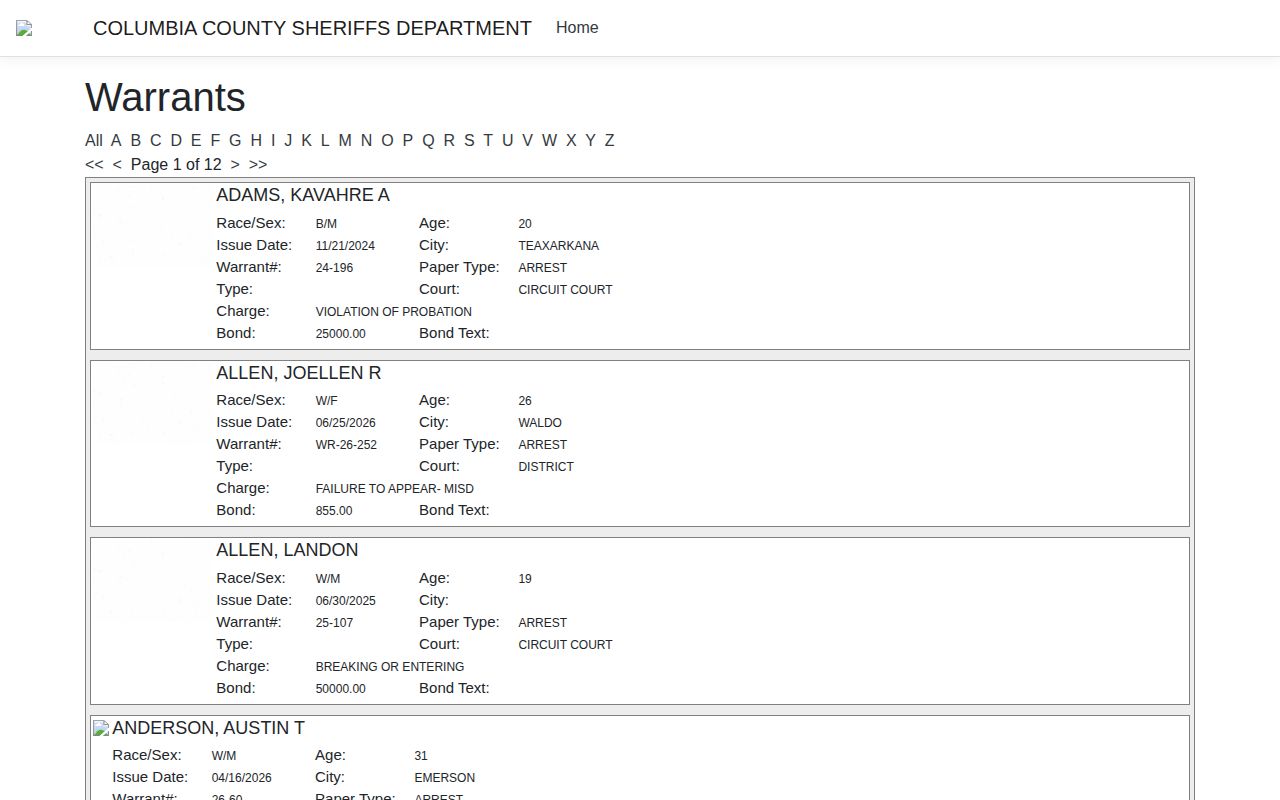
The heading, browsing tools, and record layout set this official channel apart from a curated wanted list. That difference matters for how you read what you find. A curated list means officials hand-picked a small group and ranked them by priority. This portal does the opposite. It puts the county's warrant process into one searchable interface. Nothing in it marks one listed person as more serious or more sought than another. The photo on each entry simply confirms which record you're viewing, and it belongs on the sheriff's system. For current status, contact the court named on the warrant or the sheriff's office.
Columbia County Warrant Fields
The fields give you enough to identify the issuing process and route a status question to the right court. Don't rely on a name alone. Similar names turn up more often than you'd think. A photograph by itself isn't a safe identity test either. Leave blank fields blank. Never fill them in with guesses.
| Field | What it shows |
|---|---|
| Photograph and name | Official identification display; neither is proof of guilt |
| Race, sex, and age | Administrative descriptors that can help distinguish names |
| Issue date and city | Process date and a listed city value, not proof of present location |
| Warrant number | The key reference for the sheriff or issuing court |
| Paper type and type | Portal labels for the legal process displayed |
| Court | The issuing court to contact for current status and resolution |
| Charge | The charge tied to the displayed warrant record |
| Bond and bond text | Displayed bond information, which should not be interpreted beyond its wording |
Put the issue date, court, warrant number, and charge together when you read an entry. An older date doesn't prove the warrant is still active. A fresh-looking page is no substitute for asking the agency directly, since online data shifts between the moment you view it and the moment you call.
Note: The portal's City value is not a person's current location, an arrest scene, or an invitation to go looking.
Use Columbia County Wanted Records
A wanted list works best for two things. You can match a face or name to an official record, or you can pull the details a tip line needs. Nothing more. Do not approach the person, follow them, snap photos, or post their name around town. That job belongs to law enforcement. Keep your search focused on verification and safe reporting, and let officers handle the rest.
- Reach the warrant portal through the Columbia County Sheriff's Office gateway so the current official link is confirmed.
- Select a surname initial and move through the portal pages. Do not rely on a cached search result.
- Compare name, age, photograph, issue date, court, warrant number, and charge before deciding a record concerns the right person.
- If useful location or identity information is known, send it through the sheriff tip route or call law enforcement. Do not approach.
- For a later arrest or booking event, use the Columbia County booking and custody channels. A warrant entry alone does not mean the person is jailed.
An arrest on a warrant can generate a separate booking record at the Columbia County Detention Center. Still, warrants and jail listings answer different questions. The warrant portal tracks the paper itself. A current roster shows who sits in county custody right now. Shorter jail feeds may reveal recent intake and release activity, while court files carry the judicial path and its outcome. Once a person moves into state custody, the Arkansas Department of Corrections offender search takes over. The county portal no longer applies at that stage.
Check Columbia County Warrants
Start with the online portal, then verify directly. The portal earns the first look because it is official and searchable. From there, contact the issuing court, which owns the case process, and the sheriff's office, which can speak to its own current records. Be wary of private sites that quote a warrant with no number and no court attached. A claim like that is thin air.
- Search the official portal by surname initial and compare all available identifiers.
- Write down the warrant number, issue date, court, paper type, charge, and displayed bond text. Do not copy or distribute the photograph.
- Contact the issuing court shown in the entry for present status and instructions. If the court is unclear, call the sheriff's public verification line at 870-234-5331.
- Use Search ARCourts to examine available public filings, events, judgments, and disposition, while recognizing that nonpublic information may be absent.
- If the record concerns the searcher, speak with an attorney or the issuing court about a lawful resolution. Follow court and counsel instructions.
A blank portal result is not the final word. Spelling differences, status changes, filing delays, sealed files, or a warrant issued elsewhere can all hide a live record from view. So finish any warrant check with direct confirmation from the court or sheriff.
Note: Never use a warrant search to dodge law enforcement; the right path is verification and resolution through counsel or the issuing court.
Columbia County Warrant Type Labels
Portal entries show both a paper-type field and a type field. The label on the live entry is what counts. No fixed public list of Columbia County warrant categories exists. Read the terms on the record itself. Then ask the named court what a given label means for that case.
| Portal item | What is verified | Best verification point |
|---|---|---|
| Paper type | A legal-process label displayed by iSOMS | Use its wording with the issuing court |
| Type | A separate warrant-type field in the public entry | Ask the named court to define the live value |
| Charge | The charge associated with the displayed process | Compare the court docket and warrant number |
| Bond text | The bond wording and value shown at access time | Confirm current terms with the court or sheriff |
Only the court can tell you what a warrant label means in a specific case and where that case stands right now. A clerk can translate the paperwork type for you, though it never replaces the actual warrant number. Read the portal label exactly as written. Then let the issuing court define it, since local procedure shapes what happens next. Be careful with bond figures. A number on screen is not a promise of release, a zero does not always mean no bond, and the displayed amount may not even be current. Treat any bond value as a question for the court or sheriff rather than a payment instruction, and never let a label tempt you into predicting arrest timing or outcomes.
Columbia County Warrant Tips
The sheriff's own online tip form is one way to report a wanted-person lead. It keeps things simple. There is a message box, an optional file upload, and contact fields for your name and email. Blanks are allowed. Just know the page never promises anonymity. It never mentions Crime Stoppers or a reward either. Leaving the contact boxes empty does not make a tip anonymous, so weigh that before you hit send.
You will find it at the Columbia County sheriff tip form.
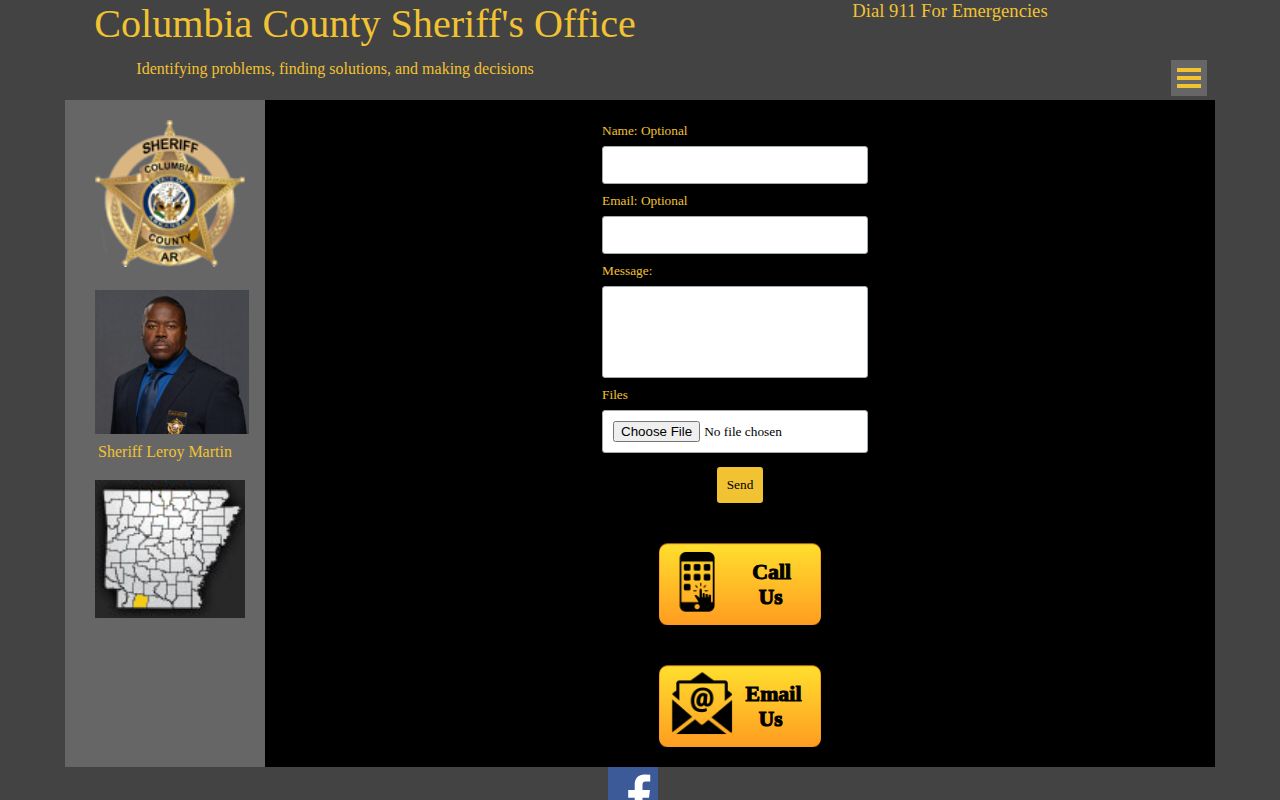
In short, the tip form offers a message area, an attachment control, and optional contact fields. Nothing on it guarantees anonymity or a reward.
Columbia County Sheriff's Office
82 Columbia Road 300
Magnolia, AR 71753
870-234-5331
Use 911 for an emergency. Use the official form for non-emergency information.
Columbia County Warrant PWA
The sheriff's official "app" is a progressive web app. A PWA is just the sheriff's website installed to a phone's home screen, not a native app-store product. That matters here. A similarly named native app exists for Columbia County, Florida, and the two should not be confused.
Installing it takes a few taps. On an iPhone, open the sheriff's PWA installation page in Safari, tap Share, then Add to Home Screen. Android users can pick Add to Home screen or Install from the Chrome menu. Allowing notifications is optional. Once installed, the PWA reaches the same roster, warrant portal, tips, releases, and VINE resources as the website.
It is not a second warrant database. An alert does not confirm that a listing is still current, so check the live warrant portal or the issuing court before acting on anything. There is no verified social booking gallery or "Warrant Wednesday" feature. Sheriff releases and special alerts supplement the portal rather than replace it.
Note: Notifications prompt a check; they do not establish identity, current status, custody, or a court outcome.
Resolve Columbia County Warrants Safely
Phone scammers have targeted Columbia County residents. The stories vary: missed court dates, skipped jury duty, unpaid fines, old warrants, lapsed registration. Then comes the demand for payment. The sheriff's office stresses one thing. It will never demand Bitcoin. Hang up if a caller pushes a payment link, a transfer, or a specific number to call back.
Verify on your own. The sheriff can be reached at 870-234-5331. The court named in the official warrant record is the other reliable contact. Never send cryptocurrency or gift cards because of pressure from someone who called you out of the blue. A real case behind the story still does not make the payment demand legitimate.
If the warrant involves you personally, talk to an attorney or the issuing court before anything else. Get the warrant number, the current case status, and the correct appearance or surrender process. Let counsel arrange the next step where appropriate. Skip private intermediaries. Search ARCourts can show public filings and upcoming events, but the filing-court clerk handles procedure and an attorney gives case-specific advice.
After resolution, a warrant can still lead to appearance, booking, amended charges, dismissal, plea, trial, or judgment. The court record is where the final outcome lands.